
Most people believe that transformation requires something really complex, but in reality, it begins with one small interruption. Learn more as we discuss Stop. Challenge. Choose: Your Best Friend.
Video Transcript:
Dr. A: …Fire, and I think we’ve all, over the weekend, have seen things happen that just almost ill-defined reality, and so today specifically I wanted to talk about Stop. Challenge. and Choose., this is a technology I developed, literally over 20 years ago, and I found it really helpful. It kind of helps us regain control over our prefrontal cortex. It also helps us, really, in the moment, start to refine, change our identity to who we want to become. So you know, so if you think in general, when we think about the future, because our future self is calmer. It’s able to get stuff done from a rational level. It decreases the Drama Triangle and gets us in position to truly make a difference.
So today we’re going to go over this in a little more detail. Some nuances I’m going to talk about when I developed it, and things I’ve learned over using it with helping people regain control of their rational mind. And we’re going to start basically with Stop. Challenge. Choose. Your best friend. So really, it’s a simple practice that can dramatically elevate your life. You know, most people believe that transformation requires something really complex, but in reality, it begins with one small interruption. Just interrupting our patterns, our behavior, our thoughts, our emotions. Because most of our life we live on autopilot, and that’s not failure. It’s efficiency. But efficiency without awareness can move us in the wrong direction. So today I want to introduce you in a little more detail to a practice that becomes your inner ally: Stop. Challenge. Choose.
So autopilot is a necessity in life. It’s unconscious efficiency. It allows us to drive, walk, speak, operate without draining our energy. The problem is not that we run on autopilot, but the problem is that we do it unconsciously. We are unaware of our old conditioning that we’ve had for many, many years. We’re unaware of the fear and habit patterns that quietly make our decisions. We’ve kind of got our story, our shtick, and we kind of go with it, and we stay with it, and we think it’s authoritative. We think it is actually the truth, when the reality is, it couldn’t be further from the truth.
So, we’re going to do some exercises today, and then we’re going to open this up for questions because I know you guys are going to have some. So, the question isn’t whether we’re efficient. The question is, are we aligned? Are we aligned in what we do with our behavior? An example is, you’re in the office, and you’re working, and somebody comes by and as they go by they say something to you, and it just strikes you wrong and right then – boom. You’re now having this rumination and thought about all these things that are happening and you’re making up a story and your ego is helping support that story and pretty soon you’re really pissed off at the person that said that and you may even go up and confront them when the reality is most of it just isn’t true, if we really use the rational part of our brain.
So “Stop” is a sacred interruption. It is having you rather than boom automatically, go into a mode, right? Usually, it’s defensive because our ego is there and our limbic system is there to basically protect us. Protect us against danger, real danger, not perceived threats that actually may not even be true. So basically, stopping isn’t quitting. It’s not weakness. It’s a moment you reclaim your authorship over your behavior. Between stimulus and response, there’s a space, and in that space lies your freedom. Even one breath is enough to change the trajectory. So, this is something we’re going to practice today with some examples, and then we’ll talk more about that.
So, when you stop, you move from reacting to observing. All of a sudden, you’re going from that mode. It’s actually why I left critical care to go get people healthy, was to be able to go upstream and help, have people understand, why am I getting sick, and what are the things I can do to avoid that? So, you know, we’re now very much in a period of time where metabolic health is becoming in the forefront of everything most people are thinking about, and metabolic health is the forerunner. If you’re healthy metabolically, you put yourself in position to remain healthy for the rest of your life. And your health span and your lifespan stay like this. But when we react, when we wait till we do the wrong things, like eating the wrong food, I mean, it’s as simple as that. If you eat ultra-processed, unhealthy food, you will build, almost surely, metabolic syndrome. Metabolic dysfunction is where it’ll start. Your insulin levels will go up, and then eventually you’ll start getting the disease states, cardiovascular, diabetes, all these things will happen later on. So what we want to do is we want to be able to stop, and challenge, and now observe, what am I getting ready to eat? Am I going to go into this fast food store, or should I stop and get a salad, or should I go somewhere else? Just by understanding and observing, we can start to break these patterns. Because if you go in the morning, buy a Dunkin’ Donut, and bottom line is, you didn’t sleep well the night before, and you want a little sugar rush and a little caffeine, you’re going to stop there. And even though it’s unhealthy for you, you’ll do it because you’re not actually observing what you’re getting ready to do. So instead of going in, stop while you’re still in your car and say, “You know what, I’m going to shift my emotional reflex to my conscious presence and I’m going to say, ‘Hey, my prefrontal cortex knows that I shouldn’t go into this store because there’s nothing in that store, that particular store, that’s going to help me be healthy.’”
I mean, that’s how it works. It’s that powerful. You become the center of discernment and wisdom. Awareness is the interruption that makes all growth possible. If we’re not aware, if we’re on autopilot, we keep doing the same things over and over and over. And basically, defining insanity is expecting a different result. So once you stop, you challenge — our thoughts feel true because they’re familiar to us. Familiarity does not equal accuracy. The mind’s primary job is protection, not truth. Challenge invites curiosity, and curiosity dissolves distorted narratives – things that we say that just aren’t true. So, if you think about it, there are common scripts. We probably all use them when we’re on autopilot thinking. Notice how absolute they sound. Always, never, can’t, should. When examined, most of these beliefs weaken after limiting beliefs survives by avoiding examination. So the things — “This always happens to me.” Think about how many times you say that, or “I don’t have a choice,” or “That’s just who I am.” “Now isn’t the right time.” These are all things that we use in our minds. Our ego says to us, and they’re just not true. They’re basically distorted reality. So after you stop and challenge, you choose. Choice is not about perfection. It’s about our identity. It’s who we want to become. Each decision is a vote for the type of person you are becoming. Small conscious choices compound your destiny. So over time, by incorporating stop, challenge, and choose into your daily life, you can basically move to the identity. Our identity is changed. Becoming. Going from an unhealthy person, 90% of us have metabolic dysfunction. And that means specifically, we’re not in our optimum state. And even though you may not know it yet, your insulin level may be up. And bottom line is that’s because of the choices we make.
So basically, by making a different choice, we’re starting — it’s a choice or a vote. If you eat a salad for lunch rather than the cheeseburger, that’s a specific choice, a decision that I’m choosing to be a healthy person. Not, oh, I can’t eat a chocolate chip cookie because I’m going to get fat, or I’ve got to lose weight. No, you don’t eat a chocolate chip cookie because you’re choosing to be healthy versus being unhealthy. It’s as simple as that. And each of these micro choices that you make — so really, the purpose of this talk today is to really have you bring Stop. Challenge. Choose. – I know people use that, and I’ve heard lots of people say it’s really helped them, but I want to make sure that everybody, this is such a simple tool, but it can start moving you, and remember, you move from an unhealthy identity to a healthy identity or a healthy person by changing your standards. Each week, by changing your standards and raising your standards, you become healthier.
I make my bed every day and I’ve been doing it for years now because, you know, years ago, I read about an admiral that did a video and talked about what a great thing to start your day, specifically something so that with the end of the day, when you go back, and you go back to your bed, your bed is made and it’s ready. You’re ready to get in it. I mean, it kind of frames, what I talk about in the Habits of Health about your twilight hour in the evening and your model morning. So all these things are possible for us. So basically, the defining question is what would my future self thank me for right now? In other words, we all know the times when you’ve decided to make a choice, like rather than sit on the couch and watch Netflix, you ended up going for a walk and taking the dog out for a walk or walked with your spouse and had a great conversation. And as you come in, that choice says, you know what, this is good. This is really good. And you can collapse time by asking this question because it pulls you out of that short-term emotional relief where, oh, I’m tired. I’m going to put my feet up on the couch, to you know what, if I go out for a nice, I’ve been inside all day. I’ve been trapped inside. If I go out for a walk right now, God, it’s going to feel good. And it starts creating long-term alignment.
You’re starting to now make choices that move you forward and align you for what you want for your future. You don’t choose outcomes directly. You choose your identities, and then identity generates outcomes. Your future self is wiser, calmer, and more integrated. Borrow from that wisdom. So, this is a repeatable loop. I use it all the time. It’s, you know, there’s points — I had a problem with the AV part of my Savant, intelligent house, so to speak. It wasn’t working right. And I was starting to sense, boy, I’m getting a little irritated. I want to watch what’s going on in the world. And it doesn’t want to let me move forward. But I stopped. I challenged, and I just said, you know, take your time. So if you have to sit here and hit the thing 10 times to get it to move to where you want, so what? Right? It’s 15 seconds. God, I remember when I was a little kid — you had no remote. You had to go back, and you had to bang on the TV and take the rabbit ear antennas and move them around just to get the fuzz to go away. Right? So I mean, we’re so advanced, and we expect everything; we expect a room with a front window in it. We expect everything, and simply by retaking, using this loop, it’s about self-leadership. It’s about taking control, not getting emotional, because when you get emotional or get upset, whether it’s the person ahead of you that’s driving slow or my TV remote, the only person that gets hurt there is you because you’re going to release frustrations, cortisol, epinephrine, and all those things have a negative — especially if you’re sitting on the couch and not running from a saber-tooth tiger. Basically, it’s going to have a negative effect on — it’s going to raise your blood sugar. It’s going to help create metabolic dysfunction.
[00:11:53] This is really about befriending yourself. Let me be kind to myself. Let me stop. Let me have the courage to stop, basically challenge and to choose an outcome that leads me in the kind of behavior I want to see for my future. Basically, your best friend tells you the truth, holds you accountable, and wants you to grow. So, we’re going to do an exercise here. I think this is really important. So, I want you to spend a moment and think about a recent reactive moment. Okay? So, kind of find that where that is. Could be something that happened today. Something in your morning that might have irritated you. Your coffee was too hot, or the kids weren’t behaving. They were late to get on the bus. They were late to get to school. Your dog couldn’t hold it and pooped. It doesn’t matter what it is, but think of something that bothered you, and you reacted to it, and you felt that icky sauce coming on. So, we’re going to do this embodiment now. So, I want you to close your eyes. Everybody, close your eyes. I want you to take some breaths and kind of — even for myself — because I’m giving this presentation. I’m going to take some nice, slow, deep breaths and kind of feel everything. Kind of clear and think of that moment today or yesterday or over the weekend when you found out what was going on in the Middle East. I don’t care what it is, but something that upset you. Okay, where could I have stopped? Where did I go with it? Could I stop sooner rather than react to it? Because once you’re in the Drama Triangle, once you’re, you know, pointing out who the villain is or who the victim is or basically, who the hero is, any of those modelings, then you’re down in the Drama Triangle. And once you’re there, you’re emotional. Your limbic system is churned up. Your amygdala is running at high octane. And at that point, it’s too late. And so I want you to think about recreating whatever it was, and then basically, when could I have stopped? Where could I have stopped, and then what story could I have challenged of what was going on and what different choice was available?
So take a screenshot of that because I think it’s really important if you could use this modality. You know, a similar thing we talk about is upset technology is, what happened? What was missing? What’s next? What we’re doing there that’s just like Stop. Challenge. Choose. It’s allowing us to basically take control, calm down, and create another scenario where, rather than letting the natural tendency of our story, our pattern get us upset, react to it, instead, you’re stopping, you’re stopping that pattern, and then you’re basically challenging. Challenging what story could I have challenged? What in there is something that got me upset? And then what different choice could I make? So, take that down, and I’d love to have you start using that.
So, consciousness is relationship. It’s not about perfection. It’s about being present. Being present, whether you’re using your breath to do it or you’re just stopping your behavior when you feel something. You know, I call it the “icky sauce” because it’s your autonomic nervous system getting you ready for a potential threat. Again, 10,000 years ago, you either did one of four things. You either fought, turned around and fought, you ran the hell out of there, you froze, or you fell. Any one of those four. All of them were defense mechanisms. Some of them more effective than others. And now we’re using variations of that. The difference is, back then, if you were getting ready to fight, your body prepared you for battle. It made you stronger. It released cortisol to make you feel stronger, to epinephrine to actually be stronger. We’ve all heard about people that, you know, could lift a car or something heavy off of someone that fell in that moment. But when you’re every day, doing it multiple times during the day, while you’re sitting on the couch, epinephrine, norepinephrine and cortisol are being released, but you’re not eating them up. You’re not using them to run like hell or to fight. So what ends up happening is it’s in your body, and it’s circulating, and it’s causing stress, and it’s causing your insulin to go up, and it’s causing all this dysfunction, and your blood sugar goes up, and it’s having over time, an extremely deleterious effect.
In fact, 10 plus years ago, I started saying emotional mismanagement is the leading cause of death in the world. So, if that’s true, would you not want to use these mechanisms? Because they can basically — it’s about turning toward yourself instead of away. It’s about being present. Okay. Stop is courage because it interrupts that unconscious momentum. If you start getting into that, by stopping, even if you’re starting to drift down. Stop. Time out. Stop. I’m stopping. I’m using the breath to regather myself. I’m challenging. Why am I feeling like this? And then I’m choosing an outcome that allows me to move forward from an observation that allows me to do something that helps maintain my health. So if you’re frustrated with somebody, go for a walk. I always talk about, you know, basically taking some water. If I’m in some type of meeting that’s kind of, there’s some arguments going on and there’s something that I can feel, I’m starting to sense a little bit of tension and before I speak I’ll always take my water bottle, open it up, take a drink of water, sense, okay, am I ready to talk? Am I talking from here, or am I talking from my emotions from my limbic brain? If I’m about ready to talk from my limbic brain, I take another water. There’s no hurry. People are gonna go, “Oh, hurry up and yell at me or hurry up and argue with me.” No, they’re basically what they’re about. They’re in the same state in the drama. And so they’re basically wanting to accelerate it. And what you want to do is stop, slow it down, regain control of here, and decide an outcome where you’re not ruining relationships, you’re not eating a bag of M&M’s, you’re not drinking a bottle of vodka. You’re actually now taking control of your health and your life.
So there’s courage involved. Especially for long-term patterns or long-term behaviors or patterns. We want to get pattern recognition. And the way to do that is by stopping, because once you get into it, you’re not going to recognize you’re in a pattern. You’re going to think this is my reality. So challenge is the truth. Because it requires honesty about the stories we carry. If you really think about it, most of the stories we make up. They’re stories based on past circumstances. They’re based on past observations. They’re based on things that have happened to us when we’re growing up, and we kind of say, “Okay, this is just more of the same.” Because our brain likes to do comparative reality because comparative reality doesn’t think a lot of thinking. That’s what stereotypes, that’s what prejudice is. It’s that, “Oh, that kind of person does that.” And so we standardize that and say, “Okay, that explains that behavior.” When the reality it’s not us being curious, observing, and really trying to separate what is the truth here versus what I think because this story is, just like a story I saw last week, or when I was 5 years old, same thing happened. So, so important.
Choose is love and action because every conscious choice is a declaration of who you’re becoming and no judgment. We don’t want judgment here. Judgment is basically part of that stereotype of that comparative reality that of us what we know happens here, and, oh, this person is not a good person or this person is a great person, because basically that’s what we think from our past. Choosing a new reality, choosing to dissect your story and actually create an entity or identity that allows you to move forward, is the secret to really creating a vibrant, healthy, non-emotional, full life because you’re not stuck. These are your old reactions, and every one of them can be changed. But not if you’re on autopilot. You have to be conscious. You have to be aware. You have to sense. And that’s why meditation, just sensing, you know, all that. People say, “Well, I meditate, but I keep hearing that noise.” Good. Good. You’re hearing the noise. But you’re not the noise. That voice in your head is not you. That is actually your ego, your personal mind trying to reach in there and protect you from the bad, wanting to be the hero to keep you in a certain way because, oh, that’s just who they are and what they do, and I don’t need to worry about that because that’s just the way it is or I can’t change because this is who I am or this is how I was brought up. No, those are your old patterns, and pattern disruption is the key to truly becoming and evolving, to be the Dominant Force in your own life and then to allow you to organize your life around what matters most.
[00:21:22] So, you’re one pause away from a different future. So, so important. So practice in the smallest moments in traffic, in conversations, in moments of frustration. This is where your identity is forged. Bottom line is, this practice repeated daily becomes your inner compass. And when you learn to befriend that compass, you learn to befriend yourself, and you become a kinder, more open, more curious, more fulfilled and happier person. There’s no question about it. So, that’s it. Let’s, Rach, let’s get into it.
Rachel: All right. First up, we have Jennifer. Hey, Jennifer.
Jennifer: Hi, everyone. Dr. A, thank you so very much for your time and for providing these gifts.
Dr. A: You’re welcome.
Jennifer: Shortly before this call, I got a text message from someone with a picture of my estranged adult son in a hospital bed, and he’s okay; however, there’s back history. There’s trauma. There’s mom guilt, and mama bear feelings because even though he’s grown, he’s still my baby, and I want to be there to fix him and going back to trauma. And I’m sure people can relate to something I’ve said already. So before the class started, I started journaling and started saying, “I’m hurt. I’m angry. I’m sad.” And what I’ve learned from you, Dr. A, is I am not those things. I am feeling those things. I am not my thoughts. I am experiencing my thoughts. And so I wrote in my little journal, nope, rewire the brain. I’m feeling these things, and then I said, you know, oh, my 12:00 started. I’m going to hop into there. And then I started making notes. And I realized I’m rather new in my journey, but I keep coming around, and I stay plugged in with my coach and the team that’s, you know, within my little area. And I struggled with Stop. Challenge. Choose. But I realized I literally just did that while I was journaling. I stopped and noticed myself starting to go down that destructive thought pattern, that habit I have of, “Woe is me,” and I should have done this in the past, and I should have done that. And I challenged that and chose differently. So, I just had to share my experience with everyone and give you your flowers while you’re here, Dr. A, because what you’ve provided to us, the gifts and knowledge that you share with us, is truly making a difference for people in so many different ways. So, thank you. If you’re new around here and you’re struggling, keep sticking around because I guarantee you, you will hear stop, challenge, choose enough that you’re going to one day be like, I just stopped. Now, what do I do? Now you get to: Stop. Challenge. Choose.
Dr. A: Well, Jennifer, thank you for sharing that. That’s great. And, you know, it’s not about perfection. We’re all doing it. You know, we all have it happen to us. It’s a matter of really starting to become the author of your life. And leading from the future, you know, our goals, our thoughts for what the future holds are there because we live in the most distracted time ever. If we allow us, in our primordial state, you know, with our limbic system fully activated, we’re going to be miserable. You’re going to be miserable because most of the time, the world is not going to be the way you want it to be. So the whole deal, what determines the outcome, is how you respond to that world. And for most of the things, you know, we take it, you know, the world, there’s 8 billion people in the world. There are a lot of different scenarios going on, but we somehow think that everything revolves just around us. And I think it’s really important. It’s like a clock, you know, it’s a broken clock. It’s correct two times a day. So, you know, our ego may have perfect circumstances a couple times a day for us, but most of the other times, it isn’t. And if we’re reacting, going down into that Drama Triangle, our lives become miserable. So, you are taking those moments and understanding your identity. You are becoming a person who has psychological flexibility, that can take something like that. Yeah. Innately, you’re a mom, and you’re going to have those deep tendencies, and they’re going to be there. But you now, have a full grown man, and the reality is if you Stop. Challenge. Choose., you know, I have very little or no control. I am not in charge. They’ve left the house. I had my job to do years and years and years ago, whether I did the best I could at the time, right? [00:26:14 – crosstalk] and that’s why, really, I think it’s important when we think about our parents, and we’ve got a dysfunctional relationship, they were doing the best they could do. They didn’t know any different. They didn’t know any better.
And so this technology, like Stop. Challenge. Choose., are just ways so that you become, you’re starting to become the Dominant Force in your life, and you’re becoming a person that can handle anything. And I love the saying, “water on a duck’s back,” because that’s what it becomes. Where, rather than letting it, you know, get soaking drenching wet, you just let it roll off and then you — not that you’re putting your head in the sand. You’re addressing if there’s something you have to do, but you’re now doing it in a non-toxic way, where you’re not destroying your body. And if you’re in a dysfunctional relationship, sometimes we have to look and say, “Okay, I can do all I can do, but it at this point, does it make more sense to actually abandon that relationship?” Because we have a tendency to become codependent, where we stay in a relationship because it satisfies the hole that we have in ourselves. What you’re looking for are co-committed relationships where people build strong — and sometimes you have to get away from the people that you’ve been as you change. I mean it just requires that because we are highly influenced by the underlying structure and if we’re working on our health and every Friday the gang goes to a bar, on Friday afternoon after work, well then that’s not going to be an environment that you can overcome. So it’s better to stop and challenge. You know what? Today I’ve got some other plans today and then do it and that works in everything in our life. So, thank you Jennifer for sharing. That was awesome.
Jennifer: Yes. Thank you.
Dr. A: You’re welcome. Cool.
Rachel: All right. Next up, we have Georgia. Hi, Georgia.
Dr. A: Hi, Georgia.
Georgia: Hi. Okay, so I did not plan on doing this today at all, and I have pink hair!
Dr. A: Well, this is courage. This is courage.
Georgia: So, this is huge. Oh my god. Okay. I’m going to try not to get emotional and take too much time.
Dr. A: No, get emotional. I don’t care. No, no, no, no. You’re here to state, communicate. If you get emotional, that is fine. You’re not trying to just be something. You’re trying to be exactly who you are. Okay?
Georgia: Okay. Remember that. You asked for it.
Dr. A: I got big shoulders.
Georgia: I’m coming up on my five-year health-aversary. I lost 110 pounds on program. God changed my life through this program, rescued my marriage. Stop. Challenge. Choose., literally saved my marriage. It still does because I have to think every time I respond to my husband, who can be very sarcastic and very defensive, and Stop. Challenge. Choose., helps me to not be as reactive. Right? So, it’s not just food. Like in the beginning when I was losing my 100 pounds, it was food, right? Stop. Do I really need this, or can I go have my brownie? Right.
Dr. A: Right. Yep.
Georgia: And it was great, but it changed everything in my entire life. And I’ve got like the chill, if you know what I mean, because it literally saved my life. Then God prepared me. He retired me from teaching for 16 years. He had brought me my Optavia business and replaced my school income. Insert income disclosure, and I didn’t know what he was preparing me for, but he retired me in June and in November, I got diagnosed with endometrial cancer. I had just finished the 75 Hard Challenge on October 11th. I was 60 years old. I just turned 60 years old, and I finished the 75 Hard. I had abs for like the first time in my adult life. I was obese for 35 years, and that’s what brought the cancer. I know. And I was like so fit and so pumped and so on fire for life. And the cancer came. I had surgery, double surgery. Turned out I ended up having a cancer – a kidney tumor also. I figured out that I could get a double surgery because it was the same robot. Had a double on Christmas Eve of 2024. Kidney tumor, hysterctomy, radiation after that, rang the bell on March 10th, and then last July, I got hit with stage four recurrence. Inoperable. Scattered in the lymph nodes. So, I had to start chemo, and I went through so much stuff, and like I went from being a workout beast for 75 Hard, doing an hour and a half of working out every single day, rain or shine. It was hurricane season and I was out on my line in the hurricane getting my 45 minutes of outdoor through the hurricane, you know. At convention, at different things, Ignite Dallas, all the things. And I had to stop. I couldn’t work out anymore. I couldn’t do the things. Now, it turns out I have a surgical hernia with two tumors in it that is an umbilical hernia in my abdomen, and I can’t do ab exercises anymore.
I tried to, about a month ago, and I ended up fully inflamed and now I’m watching my body change, and I feel like I’m never going to get back to where I was. Like I’m not going to – and I know I’m supposed to be thinking about moving forward. This isn’t about going back to who I was. I know. I do the mindset work. I know this is Georgia. Actually, I’m working on 4.0, not 3.0. And I know that I’m going to change moving forward. So, every day I make the choice. I do Stop. Challenge. Choose. All day, every day. Every morning I wake up, I have a bald head and I’ve been bald since September, and I just got eyebrows back. Like, that’s a miracle. I finished chemo in December, and every day I have to wake up. And today I went on a Zoom meeting with my team and shared my pink hair that I got brave enough to get this for Go Global, and to be like my friend Sarah, who is known for her pink hair. And I made the choice, I’m going to go make myself not feel like a cancer patient. I wake up every day determined I am not going to look like a cancer patient. I am a cancer warrior. That is just a little part of who I am, and I’m going to do this, but I can’t seem to get back into a workout routine. I can’t – I’m turning into this flabby thing. I feel like a big marshmallow. I’ve gained a little bit of my weight back, and I’m also struggling with nighttime binge eating. Now, the good news, I don’t binge eat on, you know, Hershey bars, Lays potato chips, and Häagen-Dazs, like I did five years ago. But I’ll have too many sugar-free Jell-Os and too many sugar-free ice pops and, you know, too much Optivia popcorn, and I can’t figure out what my problem is. Like, I’m stuck. I can’t get back into a routine. I had it, and I can’t get there.
Dr. A: So, first of all, you’re incredibly brave. Incredibly brave. And you’re doing underneath circumstances because life is intrinsically unstable. We are all born, we all die. Some of us get two years. I worked in a pediatric oncology clinic in one of my rotations, and those kids who didn’t make it past two. So bottom line is you have taken adversity, and you’ve done a beautiful job of having the courage to stop, challenge, and choose what your reality is. Okay? And you’ve done an amazing job of it. Don’t beat yourself up. You’re right now, if I looked at everybody that has the same disease process that you have, which you didn’t ask for. You didn’t ask for any of that. I would say that you’re in the top 1% of how you’re handling it. Okay? So, that’s the first part. So, you need to stop being unkind to yourself in any way, shape, or form because you’re doing it. You look amazing. You have a beautiful smile on your face. I know you’re hurting inside because you’ve achieved so much. You went up to the mountaintop. You got in the most incredible shape in your life. And you’ve learned how to control everything from your relationships to your relationship with food. So, you’ve done an incredible job. So I don’t want you to beat yourself up, and in case of what you can and can’t do. Okay. So yeah, you’ve got some hernias, you can’t do setups, those things will all pass. I mean there — none of those things are, you know, and possibly surgically you could have that done, you know, done and repaired because those are not major operations. But the point being is that you’re getting up every day and asking what can I do today to maintain my health, my fitness. And the most important thing you do seems like you have a really good handle is, in here. You really have the psychological flexibility to take a lot of adversity and deal through it and maintain a positive outlook.
[00:35:37] And by the way, in terms of your longevity and the quality of your life, what you’re doing in that area is the most important thing because again, life is intrinsically unstable. But you’re taking your circumstances, and you’re responding in a way that’s determining an outcome that’s allowing you to maintain, do the things that are important to you. And I’m really proud of you, and you should be really proud of yourself. So that’s it. Couple things that you can work on is that you want to make sure that, because you can’t exercise the same way, you could before that you’re looking at the other MacroHabits. Right? So in other words, in terms of you can still walk. You can basically stand versus sit. You can…
Georgia: I got my ball.
Dr. A: Yeah, you got your ball! There you go. You’re on a ball! Right? So, you’re using the NEAT, non-exercise activity. So, you’re doing the things, and you’re — you know, we’re all – listen, we’re all born, we all die. That’s our inevitable. We all have that in common. I don’t care how rich you are, what’s going on. But you decided to have the courage to become the Dominant Force in your life and then organize your life around what matters most. So, you’re doing an amazing job. What I would make sure is that you are staying away from any sugars at all, anything, because not only is it bad for your metabolic health and your insulin resistance, it also feeds cancer, right? And we know that. So, you have a double, like you say, you had a double operation. You got two for one. You actually know that sugar is a no-no in every way, shape, or form. And Jell-O, even though it doesn’t have sugar in it, it loads your pancreas. Your pancreas, when it tastes that sweet, your body tastes that sweetness, it will pre-load and raise your insulin, get your insulin level. So when you do have something that — you’re boom, it will release it. And we know that. So basically, make sure you’re eating healthy proteins, lots of healthy fats, and if you do carbohydrates, make sure they’re complex, like in their natural construct. You know, like natural fruits, like apples. Stay away from, obviously, bananas and things that are full of sugar, but you know that fiber is good for you. It’s got phenolic compounds in it, which are antioxidants, and they help your body’s immune system respond. Making sure you’re taking you know nice herbal teas, things that actually boost your immune system, green tea and stuff.
So just focus on the things — because that’s important to you. And when you’re ruminating, like you say, when you can’t get over, and you’re doing more, you’re actually letting yourself go, slide back, because you’re frustrated and you’re trying to do this on your own. The other thing is, use your friends. Make sure you’re in robust conversations with people that love you and care about you because those are the things that can really fuel your soul and put you in position. Listen, Deepak Chopra, years and years and years ago, did a study, and they looked at people with cardiovascular disease and some of them had what we call the widowmaker left main lesions were almost totally occluded and those people lived to be 80 and 90 because they had the right attitude in here. And then there’s people in their 40s that died of a massive myocardial infection with no sign of structural change in their arteries, but because of dysfunction in here. So fuel your mind. You can do that. Fuel it with this beautiful — that you’re a warrior. You’re a warrior, and you’re going to go for every moment of life that you can, and you’re going to stay functionally healthy so you can do the things that are important to you and keep doing that and be kind to yourself. Be kind to yourself. Does that make sense?
Georgia: It does. I mean, I didn’t include the part that I’m getting immunotherapy for the next 19 months also. So…
Dr. A: Well, this is part of this; life is intrinsically unstable. You got, you know what? You got lots of stuff – and by the way, when I say, you know, become Stop. Challenge. Choose., not let yourself get dysfunctional, your emotions, okay? You have damn good reason to be emotional about things like that. So have a good cry. You know, let it feel it all the way through. Don’t try to deny the natural sense of your mind needing a good cry. There’s nothing wrong with a good cry.
Georgia: I try to be the tough guy.
Dr. A: No, no, but that’s not helpful because if your conscious and your subconscious are in this constant battle with each other, and if you try to repress it or suppress it, it will go down there and it will come up. So when you feel it, you know, go have a good cry and have a cry with friends. It’s okay. Cool?
Georgia: Thank you. Thanks. Thank you so much, sir.
Dr. A: You have a lot of courage. Really. Courage.
Georgia: Thank you.
Dr. A: Yeah. It’s good stuff. Okay. Who else do we have?
Rachel: All right, next up, we have Emily.
Emily: Hi, Dr. A. I’m kind of with Georgia. I really wasn’t expecting this, and thank you, Georgia, for everything that you shared. You’re an inspiration to me, and you’ve inspired me to go get my ball out sitting in my closet, blown up, and I’m like, I could be sitting on this thing right now. So, I don’t know where my question is, and it’s not on the screen, so it wasn’t really a question for myself — oh, there it is — about identity shifting and about how you went from doctor to coach to visionary, overcame the fears and the griefs. Was there a pivotal moment that you noticed? I notice that I’m changing slowly, but the old identity still comes in, and like what you talked about, uncertainty, mostly with financial. I know that I’m a nurse, and I know that being a nurse, I’m always going to have stability there, but stepping into the identity of the visionary and actually seeing it for me, it’s like having, like actually seeing it and what I want, but also practicing gratitude with what I already have. Like I’m content and happy, and I know at the end of the day I have everything I need, but having that — the actual vision pulling me and seeing it. I don’t know if this is making sense, but…
Chris: We lost Dr. A. Hang on one second. There we go. Now you can, Dr. A… It was the Zoom guy’s fault. Now you can unmute.
Emily: Hi, Chris!
Chris: There you go.
Dr. A: All right. Can you hear me now?
Emily: Yeah.
Dr. A: Yeah. It wouldn’t let – Chris wouldn’t let me unmute. I don’t think he wanted to hear me talk anymore. So these are really good questions, Emily. And I would say, remember we act on emotion, not on rational thought. So you’re having a rational thought decision, and I’d rather have you have an emotional one. And you think, wait a minute, you’re just talking to me about how you have to control my emotions – not control your emotions. Observe your emotions. Find out what they’re telling you and then go for that. So here’s the most important thing. When we value something, when it is of high value to us, and I’m not talking about moral, ethical value. I’m talking about something that’s very important to us. It’s a high-value item, then you don’t need much motivation. So, it’s really about — and visionary, you know, I’ve been called that, and probably I am because I always think of what can be, right? Not what is, what can be. And you know the human being — we see, well, just over the weekend, we see the best and the worst of what humans can do, right? I mean we are a very complex species we have learned to master our environment and so we can, and with technology advancing, especially now with AI, bottom line is, this Human Transformational Technology, the ability for us to now help optimize us as human beings in a time when machines are taking over everything is really important and it really comes down to what’s most important to you. So you say, “Well, I’m a nurse,” so you help people. And I know it’s a tough job. Being a nurse is a tough job. It’s not an easy job. But you do it because you love people.
[00:44:33] So underneath, and it may be eventually that you may end up not being a nurse anymore, because you ask me, what happened to me? I always – I have an insatiable hunger to learn and grow. I love to learn and grow, and critical care looked to me, as I took care of sick people, being able to take care of the whole person as an integrated person, and take care of their kidneys, their lungs, their heart, everything together made a lot more sense than having five specialists. And in my books, I talk about the story of the three blind men touching the elephant, right? One of them touches the side and says, “Oh, it’s a wall.” One of them is touching the trunk and says, “Oh, it’s a hose.” And one of them is touching one of the legs and says, “Oh, it’s a tree.” Because they can’t see the whole vision. The whole vision for your life, and why I’ve moved upstream to where I am now. And why now, really focusing on even targeting into metabolic health is so important as a whole, is because I know now if we can get rid of people eating ultra-processed food, help reduce stress, maximize gut health, and put people in position, and why I spend so much time on consciousness now, is because Stop. Challenge. Choose., is more powerful than going to the gym. I can tell you that right now.
The gym’s great because, especially if we go to the gym, because we’ve just had a frustrating day and we can go feel better. That’s great. But imagine if we don’t have that frustrating day because we’ve gone upstream and in our mind, like water on the duck’s back? We can handle anything. That’s moving upstream. So kind of thematically, it’s just that I think — you know, when the world’s going one way, I usually go the other way because that’s where the answer is, because if everybody’s trying to convince themselves that this is the way to do it, it probably isn’t the way. It’s not being contrary — it’s really in search of, what do we really want to have happen here? And what I want to have happen here is not me being great at having to put a thousand Swan-Ganz catheters into someone’s pulmonary artery, but instead helping that same thousand people make the choices upstream, so they never need this in the first place, right? I mean, it’s kind of like, just intuitive logic. So, for you individually, it is so key to not try to figure out what people want me to be or what I see on TV or what my images of success are or health, but what’s the reality? What do I value most? Is it my relationships? Is it my health? Is it my religion? Is it my time – freedom? Is it my ability to travel? And then start there, and that will help fuel you and allow you to go into what I call “pursuit.” And pursuit means that you’re now moving towards something you want.
And why people get so stuck is because we live in the most distracted time, and our brains want to be comfortable. So easy to turn on a Netflix series. So easy to have that hot fudge Sunday because you can get it anywhere and it’s cheap, right? You can go buy a Dunkin’ Donut for, I mean, I don’t know how much — I don’t go to Dunkin’ Donut, but you can go buy whatever it is you want pretty cheap now, and food, ultra-processed food is cheap. You know, there was a time not that long ago where the world was starving, and now the world is obese, and we have diabetes and Ddiabesity, where there are more people that are overweight or obese in the world and have insulin resistance than are starving. I mean, we forgot to tell the food industry not just to make food less expensive, but to make it healthy. So all those things start with you organizing your life, and that’s why the two tenants, I’ve been saying for a quarter of a century, organize your life on what matters most and how you do that has become the Dominant Force in your life. Decide what you want, and you know my dear friend Jim Dethmer talks about, “A full body yes.” Figure out what you want. What do you want? What’s your healthy identity? What’s your successful identity? What do you want to do as far as financially, if that’s a concern? Because the lack of finances is really, not really true. It’s never really true. There’s always the abundancy living in this country. There are other countries where it’s ridiculous. But in our country, you have enough finances. The lack of it is a sense we have because we want to have wholeness in those areas. That security, belonging, and finances, and control are basic entities that we want to have because we think it’s somehow going to give us control over, right? We want to belong and so we can survive. And 10,000 years ago, you needed to belong. You needed to fit into your tribe because if you weren’t in your tribe, you were outside, and you were dead, right? And you would do that through either belonging, through acceptance, or you would do it through control. One of those two mechanisms.
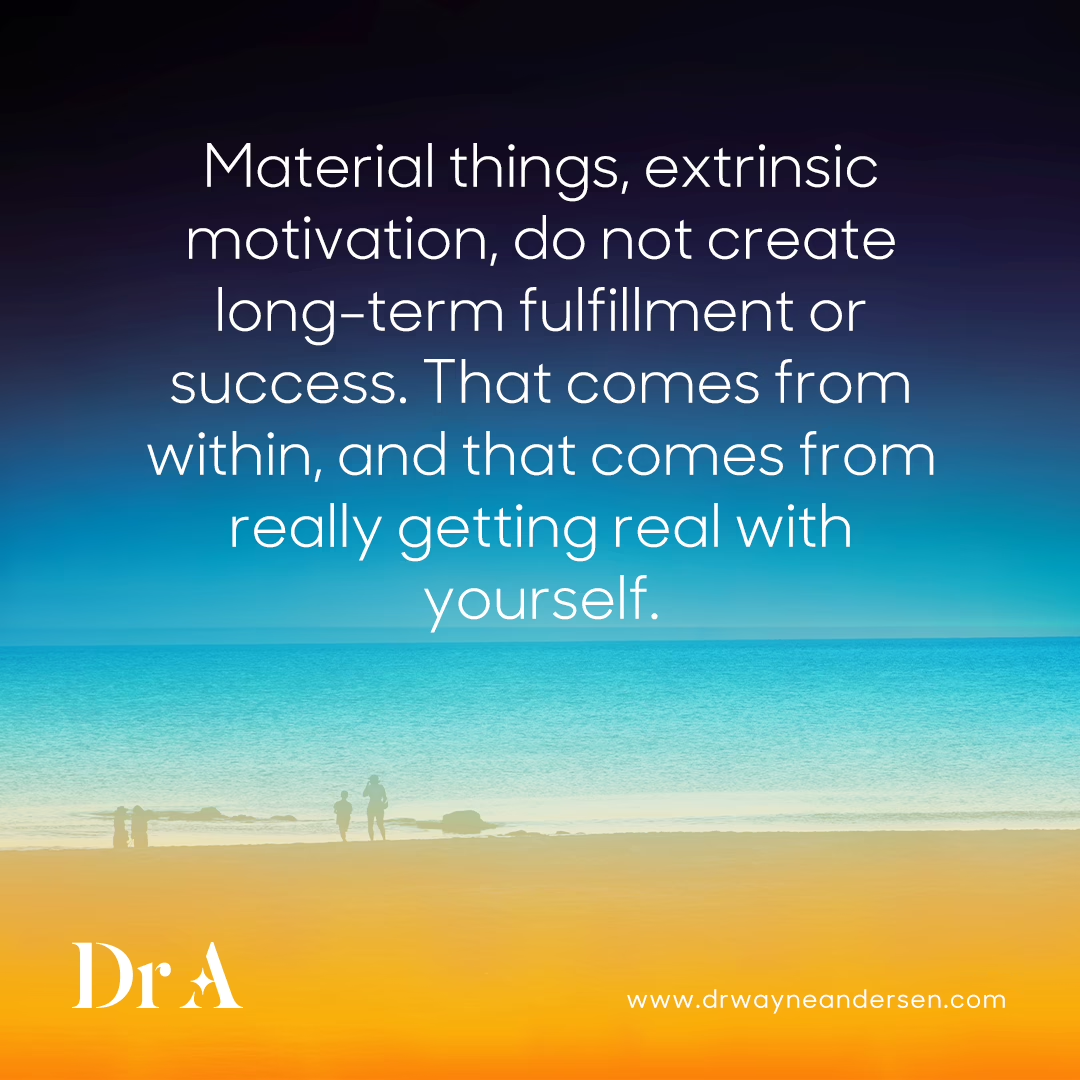
So these are primordial things we have that aren’t really what we want. We sense that we need – and if we have these things, we’ll be better. If we have that corner office, we’ll be better. If I have that shiny new car, I’ll be better. Reality is, material things, extrinsic motivation, do not create long-term fulfillment or success. That comes from within, and that comes from really getting real with yourself. And how you do that is through the topic today: Stop. Challenge. Choose., because what that will allow you to do is now become your authentic self. Get you away from the patterns of preconceived notions. So when you asked me, you know, being a traditional physician, being the chairman of my department, and a director of critical care is an identity issue. When I realized that I was taking care of the people, sometimes the same people that were, you know, it’s like getting to the point where they didn’t die, putting them back on the streets, but at home they’re watching Netflix and eating yo-yos, right? That’s not the best use of my time or their time. And you make the decision, and that inspiration to do that. And in my own family, you know, working 80 hours a week, not seeing my little girls, I made all the difference. My daughter Erica is in vet school right now, and she’s home, and we’re just having such a great time, just being together. We love and care about each other so much, and it’s just that they’ve learned what really matters the most, and I know that as well. So you — I’m taking an hour out to do this, and then basically we’re going to hang out this afternoon and talk about stuff, talk about, she’s going to a couple of clinics this summer. She’s going to go to Africa, and she went a few years ago with me and now she’s going back as a veterinary student and get to work with the animals. That was one of her dreams, and so she stayed to that dream. She didn’t get to in her first year. She went and worked in a clinic, just like I didn’t get in my first year in medical school. I basically didn’t get into my second year, but I knew what I wanted to be, and basically, I became it.
[00:51:37] The same thing for you. Don’t think that it’s suddenly going to appear. Go into your inner self and figure out what you value most and then organize your time around making sure that you’re saying yes the things that move you towards that goal, and if they’re not moving you towards the goal, because we’re in the most distracted time ever — I mean you turn on any of the stuff, someone is trying to get you to do something that they want, not what you need or you want. And what happens is because the human brain likes comfort, likes soothing, dopamine-ergic activity, likes those clicks, we go down this path. And there’s someone that’s mastered how to use the internet, you know, baiting, it goes on and on and on. So the only way is for you, our goals, what we want, what you value most and moving towards that basically is decided by you focusing on that and then using that. Your goals are — not that the goals are something you have to think about every day, but what your goals do, they act as a filter so that every day you’re only doing the things that are taking you to become the things that you want to become, and you’re saying no to the things that don’t. Does that make sense? Is that helpful?
Emily: Oh, yes.
Dr. A: Okay. So, anything from that that you want to ask?
Emily: The goals as a filter. [00:53:01 crosstalk]. There’s just so much.
Dr. A: Okay, but there’s not so much. There’s really, there’s a million things, but what’s most important to you? I think what you need to do is take the key areas of your life, your vocation, your family, your faith, your health, your mental health, take the key areas of your life and on each one of them ask first, of those seven things — there’s seven of them — of those, which one do I value the most? So, here’s an interesting thing. So, wellbeing, the Gallup, not the Gallup, but this group did a poll and looked at people that lose their occupation are decimated, psychologically, more than if they lost their spouse. Okay. Yeah. Because of being involved. Now that’ll be different for different people, and right, and also towards the end of life, obviously if it’s a couple, usually if one of them passes, then the other one passes because they’ve now — that’s all they have, and without that, they have a big hole in their life. Okay. But what I’m saying is take those key areas and figure out, of those areas, whether it’s your family — all those things we talked about, which are the most important, and put them in descending order. Put the most important first, down through the least important, and then basically when you find the most important, then say, “Okay. In the next five years, how would I like that to evolve?” I value — well, so give me one – let’s just do one for practice. What’s one of the things you value the most in your life?
Emily: My spirituality and my mental health.
Dr. A: Okay. That’s okay. So right now, obviously, we’re on today, and you’re asking the questions, you’re a little frustrated about where you are and getting stuck and stuff. So if those are the — your spirituality, and the sense of being, whatever that means…
Emily: Who I am.
Dr. A: Who you are. Okay. Who you are. [Unintelligible]. Tell me what you mean by that.
Emily: Like what my what God wants me to be.
Dr. A: Okay.
Emily: What I want to leave behind, I guess my legacy. I don’t have a husband or children. So it’s a little different place to tap into.
Dr. A: Well, if it’s a little different place to tap into and it’s the thing you value most, then clearly you’re spending too much time being distracted by other things. Does that make sense?
Emily: Yeah.
Dr. A: Yeah. It’s okay. You can get emotional. I cry all the time. I cry all the time. Okay. So what I want you to really think about Emily is if that brings – these things aren’t sayings. They’re actually the essence of life. Organize your life around what matters most to you. What matters most to you is different than what matters most to me. It’s different – like snowflakes. What matters most to you is the thing that you should pursue. And what I mean by pursue, pursue means, it’s a verb, means I’m going towards something that is one of the things I value most, and I’m in pursuit. Because a goal by itself is static. You know, you can say, “Well, I want to work on my mental and my spiritual health,” but if you’re not actually, actively, doing things to move forward and improve that, then you’re going to be more frustrated than ever because it’s something that’s important to you. So, it’s sometimes having to stop doing — Stop. Challenge. Choose. Stop the things that aren’t important to you and get better at it, and you’ll know it because if — you know, listen, it’s happened to me before and I just don’t do it anymore. I basically would do things for other people because people would ask me to.
My job in this point in my life is to help people become aware and give them the tools, the counseling and the guidance so that they can become the Dominant Force in their life. And the other part is taking the time to categorize and organize your life around what matters most to you. That is what’s most important to you. And when you’re in search of that, and you’re moving towards that, and you’re in pursuit of that, then you will feel fulfilled because you’ll be moving forward with that. But the discipline requires you to basically start saying no to a whole bunch of other things. No to dysfunctional friends. No to dysfunctional TV shows. No to dysfunctional internet things. No to a bunch of stuff that just doesn’t really matter to me, that I do to occupy time to make to kind of make me numb, right? About how I’m missing the things that I really want. You got to focus on the things you want. You got to do the work to move towards those. And you need to know the difference. It’s like the Serenity Prayer. You got to know what you can do and what you can’t do. Does that make sense?
Emily: Oh yeah. Absolutely. That all makes sense.
Dr. A: So that’s what I want you to do. I want you to sit down, really focused. If your spirituality and your mental health is the most important thing to you, then you need to focus. You know, basically, you can go to any of my books and read about it. There’s a whole section in my new book, My Prescription for Life, on your mind. In part five. The one towards the back of part five. And use some of those constructs to help guide you. And one of the best ones you can do, the halo effect, is when we identify something in our brain, and we start working on a habit change, we’re actually reprogramming, programming our neuropathways, because we have plasticity. And as you start reprogramming and saying no to what you don’t want and yes to habits, new choices that you do want, you’re improving your identity towards what you want. And as you do that, you have the halo effect. And the halo effect means that other areas in your mind, other areas and habits you have, will start changing as well, because your brain likes it when it’s fulfilled and doing something that brings satisfaction. Not pleasure, satisfaction.
So pleasure is when you eat a bowl of Häagen-Dazs, and you keep eating it because the only time you have pleasure is when you’re actually eating it, right? That’s the taste. That’s why everything’s supersized because the only time people are really enjoying it is while they’re in the process of eating it. When they stop it, the pleasure goes away. Satisfaction is a very different sense. That’s the satisfaction is that you basically went out for an hour walk with friends, bonded with a friend, got some physical activity, were out walking through the trees and like the forest bathing that the Japanese use, you’re out in these beautiful pine forests, if that happens to be what you have, or just walking, and you’re now doing things that create satisfaction. When you go home, and you get home to your house, and you’re taking a shower or a bath, and you smile and say, “What a good day that was.” Because you organize around what mattered most to you. Each one of those increments is you giving yourself love. It’s the “Choose” part of Stop. Challenge. Choose. Where you’re making a choice that helps build your self-efficacy, your fulfillment, your happiness, your connection with yourself and with others, that moves you forward into a different space.
That’s satisfaction. And you want more of that and less pleasure because pleasure is instantaneous and then it’s gone — I’m not saying — I mean, growing up playing football, my girlfriend was a cheerleader, and she made me warm chocolate chip cookies, and I’ve got a weakness for them. My girls know if they want something, I don’t do it anymore, but I used to, you know, the smell of them would be enough, and they’d stimulate my, you know, that part of my brain, and, you know, I would be done. And the problem was just like Ruffles has ridges, I couldn’t eat just one. So I don’t do that anymore. I don’t bring them into the house. I don’t have any. And now I’m at a point where that doesn’t interest me because I built the choices that I’m a healthy person, and that’s what I want to maintain. What I do love is taking my daughter that I’ve been talking about and taking her heli-skiing when I’m basically, you know, 50 years older than her and skiing at the same level, jumping out of a helicopter. That brings me incredible pleasure. We talk about it all the time. It’s one of the highlights of our life.
We’re going to be going sailing out in the ocean together in another month or so with some of her dear friends. Those are the things that really matter, and those are the things we can all have. I came from a very poor family, lived in a tenement, not a tenement, but like a three-story little house in Queens Heights, New York, and always had the desire to be more. We all have that by breaking our patterns, stopping, challenging previous behaviors, and moving forward, loving on ourselves, and making choices that move us in the direction we want. Cool?
Emily: Yeah.
Dr. A: Wonderful. Awesome.
Emily: Thank you.
Dr. A: All right. Well, we’re out of time. I apologize if we didn’t get to you. Make sure you come on the first Tuesday of the month, and we’ll continue to move forward. Have a great week. Please use Stop. Challenge. Choose. Use it a bunch of times. You’ll be so excited when things that you were doing, you’ve disrupted those patterns. You’re now becoming that Dominant Force. It’s not going to happen — it’s not about being perfect. It’s about starting to change the trajectory. And over time, it’ll get easier and easier. So, God bless. Love you, guys. Let’s keep the world safe, and let’s help get the world healthy. God bless.