
Video Transcript:
Dr. A: We’re getting excited; today’s The Human Advantage. Basically, this is our second session with our new look and feel, and we’re really focusing on the human advantage. What are the advantages we have as humans? You know, most organisms that sit in nature are totally dependent on the environment they’re in for everything. We are the exception. We have the opportunity to basically take whatever happens to us and respond in a way that determines the outcome. So we’re not in that just reactive phase. The lower organisms, all the way up to mammals, respond basically to protect themselves. We have the opportunity to actually distinguish between what real fear is and something we need to be worried about and the rest of it. And so it really comes down to, you know, what we’re tuned into. So basically, I want to welcome you all back. If you were on last month, we talked about the space between what happens to us and what we choose to do next. The space is where your power lies. Today I want to go one layer deeper into what actually fills that space. Because here’s the thing: before you ever choose a response, something has already decided what you noticed in the first place. That something is what you’re tuned into.
So basically this really sets the stage for everything we talk about. It’s our focus. It’s our tension. And as we know in the world we live in, that tension is — and presence is the key parameter. We have little control over our future, no control over our past. We simply have the moment. And learning how to tune in to what you really want in your life is critical. So I want you to sit with this for a second. You don’t just live in your environment; you tune in. What you tune into is what you create. Most of us think of our environment as something that happens to us. It’s our job, it’s our health, our relationships, the news. But every single day you are choosing a station, and that station decides what you pick up, what you miss, and ultimately what you bring or build. That’s today’s Human Advantage.
So this is the whole thesis behind this talk today. So here’s what we’re going to do. First, the frequency you’re broadcasting and the two stations most of us flip between. Second, the shift from fear to creation. Third, a simple daily practice: morning, midday, and evening. And fourth, the mechanism, because I know some of you are skeptics and want to show you exactly how this changed things outside of your own head. If we change in here, we can actually modify our environment and influence our environment. So really, really important. So tension is never neutral. You’re always tuned into some station. Always. Even when you think you’re just getting through the day, your brain is filtering. And it’s filtering according to something. As a physician, I can help ground you in this. The brain receives far more sensory input than basically it can ever consciously experience. So it constantly decides to amplify and what to ignore. You know, think of it this way. There was a study done with the invisible gorilla. There was a study done, I think in the 1980s, where they they showed a video of basically passing a basketball back and forth and people were tuned into that and basically a gorilla walked — guy dressed as the gorilla — walked in front of them and something like 50% didn’t even see the gorilla. They go, “What gorilla?” Because they were focused on this.
Now I can tell you that’s a difference between something that doesn’t really matter when you’re focused on something else. And you know, I took the girls a few years ago to Rwanda. And I can tell you when you see the real gorillas, you’re focused on them, and you’re looking at them because, you know, the gorilla’s hands are about this big and his neck’s about — the silverback — is about that big. So, but the reality is what we focus on is what we pay attention to. There’s all these things happening around us. It’s that selective attention that makes the difference. So, depending on what we’re tuned into determines on what we see. So think of it as two stations. You got two radio stations, right? Playing at exactly the same time each day. One is a fear channel. It’s one there’s not enough. Watch out. Low amplitude. Constant hum in the background. Easy to mistake for reality. It basically feels like everything is dangerous and it’s easy to make a mistake in reality. On the creative frequency, there’s enough. I’m building something. It’s not a mood. It’s an orientation. This is really important because this is not positive psychology. This is not. Positive psychology is fear-based and you put something positive on top of it. It’s like putting lipstick on a pig. Bottom. This is a change in orientation.
It’s really important because positive thinking by itself doesn’t do anything. Positive thinking replacing negative thinking based on something that’s factual does matter. So by focusing on what matters, what’s creative, we widen the frequency and we give ourselves more space, because understand that that fear frequency is really focused because it prevents us — if there’s a tiger on the savannah, you need to see it and you need to run like hell. But basically in general thinking, “Oh, I saw a snake once in the grass,” and allowing that to dictate you walking through a beautiful day in the sunshine in a beautiful grassy field doesn’t make sense. So that’s the difference between understanding what frequency am I tuned into. So basically there’s two stations moving from a defensive orientation that protects us against loss to a generative one builds what is in front of you, what’s here. One is about protecting us against loss. The other one is building for what’s here. What are the building blocks today? How can I use these building blocks, these things in front of me to create and build more in my life?
So basically, fear-based orientation it’s defensive. It protects what you have. It avoids loss. It braces you for what might go wrong. It’s living in that fear-based reality. And 95% of the world is living in it all the time. That’s why there’s so much dysfunction because you have a fear mentality and anxiety, and it leads to chronic stress. And I can tell you, as a physician, the leading cause of death in the world is emotional mismanagement. It’s not understanding what’s real, what’s not real, and creating an orientation that allows us to move through the day and focus on the things that actually build health in our lives, build mental health, physical health, and obviously success in all the things we do in life. It’s so critical. But if we don’t, basically, I can tell you real fear is when you’re in the ICU, and you have that look on your face. And I witnessed that on so many people. And the real fear is that they potentially could die. But most of it, an email, a delay, a disagreement. There’s situations that aren’t really dangerous. And we know this. We know that fear is useful when you have a tiger, but it’s terrible for problem-solving. So, now we get to the practical part.
There are three moments a day — the morning, the midday, and the evening to set, correct, and review the frequency you’re running. So, in other words, throughout your day, you’re running on a frequency. But most of us are running, as I mentioned, on the station that’s tuned into fear. The lack of. “I don’t have this.” “I need this.” “Why is this happening to me?” And in that phase, basically, all our physiology, our emotions, and even our cognitive are all contracted. They’re not allowing us to become everything we want to be. So let’s talk about that. Morning is about tuning in. Before the day starts, set your frequency. Before the phone, before the news, you choose it. You name your station and your expectation. Midday, Stop. Challenge. Choose. You catch the drift, interfere, catch that drift and ask what’s true and deliberately re-tune. In the evening, check the signal that you’ve been looking to and see what’s the gap between the signal and the tune I wanted and what I actually experienced today. And this, basically, we talk about that in everything from implementation, intentions, right? So we know this — you could say, “Okay. When I’m pouring my coffee in the morning and taking a sip, I name my station.” So by intentionally implementing that you start building the microHabit, “Yep, my day started; Here’s my coffee, time to tune to a, basically, an abundant frequency orientation around abundancy, around creation, about all the things I want to do.”
Now, we’re all going to drift. I drift. And I know now that when I feel that, when I feel that “icky sauce” or something’s coming in during the day, I immediately tune back and say, “Wait a minute. I’m below the line,” as we like to say, and I need to refocus, reorient, and move back into the frequency that moves me forward throughout the day. And this is something as a microHabit you can do. I talk about doing it intentionally at least three times a day. So that’s basically, if you think about it, that’s not much time. It’s actually taking a couple minutes in the morning, basically 30 seconds during the day, and then a couple minutes in the evening to really go over this and start using this every single day.
[00:09:53] Now, many of you know Stop. Challenge. Choose. I’ve been talking about it, created this almost two decades ago. Well, here it’s doing the real work. So stop, notice you’re drifting. Say, “I’m on the fear channel.” And the challenge: what’s actually true here? Or is this just fear narrating itself? In other words, am I telling myself a story, going back to that fear-based tune-in? And then choose to re-tune. It gives you that moment to listen, drift, and then tune back in. So important. It’s so critical. You know, it’s basically — we know this. We know if we label that feeling, which reduces the activity in the amygdala, which is the brain’s alarm system. We know a phrase such as, basically, something as simple as, “Hey, I noticed I’m drifting,” and that’s a win. That actually, when you drift and you notice, that’s a win. You’ve just said, “Yep. I was getting off frequency. I was going back to my old tendencies.” Boom. “I’m now moving back.” And that positive — it’s called an effect labeling — will actually diffuse your amygdala. When you become aware of that, the amygdala, which is that neurotrip wire in our brain that signals danger, now realizes, oh, this is just something I was starting to drift, and I was going to a different narration where an old story is popping up. And now I get it, I label it, and then I can move on. So critical.
All right. So, at the end of the day, there’s two questions. What was I tuned into today? Was I tuned into creation? When did I drift into fear and not catch it until now? And what did I expect this morning to shape in my life? No self-grading. It’s not about judgment. It’s not saying, “Oh, I really screwed up today.” That is of no value at all. It’s not about judgment. Is simply about information to say, “Was I tuned in?” So, you really need to think of it to the point where — I can tell you now that I’ve gotten so good from countless years of practice that it’s kind of like a radio station. Now, we don’t do this much anymore because everything’s digital. But remember back when you used to tune the radio, and you tune it into that exact frequency, and it would get off frequency, you’d start to hear static in the background, and it wouldn’t be quite as clear. That’s where you want to get, so that during the day, anytime that tuning away from abundancy, and this creative, and feeling full, and being oneness with yourself and everything that’s going on.
Now, I’m not saying that real things don’t happen and that you don’t have to address them. There are real things that you should be fearful of, scared of, and when they happen, you address them. Like if someone in front of you pulls in front of you, right then, fortunately, you know, the new cars have auto-stop. You have airbags, we have seat belts, we have all this stuff to help you, but that’s a real time to have that sense of fear. And you’ll feel it. That’s real fear. Boom. You feel that adrenaline. You feel that cortisol release, and your heart palpitates for a short period of time. That’s okay. You’re not wanting to get rid of that. You’re wanting to get rid of that chronic noise in the background that’s telling you that the sky is falling. You know, if you ever watch Saturday Night Live, Debbie Downer, where everything is, “Womp womp.” The reality is that once you get to the point where you’re tuned into the creative process, it becomes so resonant and it becomes so obvious. Now, going to that mental gym is going to take lots of practice. So, I’m asking you for four minutes a day now to make the choice, to decide to see where you are, and what you’re tuned to.
So, does this change anything outside my head? Well, that’s a fair question, and I want to answer it directly. Yes. And there’s no mysticism here. Here’s the mechanism. We’re going to go over this. Bottom line is, it’s — walk this loop with me. Okay. Basically, this loop that builds your environment. First, what you tune into becomes your expectation. Your expectation directs your attention. Your attention shapes your behavior and your behavior builds your environment. Expect scarcity, and you’ll notice every sign of scarcity, and you’ll miss the openings sitting right next to you. Expect to build something, and suddenly you see the material for everything everywhere. Do that for months, and you haven’t just changed your mood; you’ve changed your actual environment because it begins responding to a different signal the whole time. You’re not a bystander to your circumstances. You are one of their authors. This is so important to know. And actually, basically, I’ll give you some evidence. Alan Crumb did a milkshake study where they took the same milkshake, a really rich, frothy, amazing milkshake, and they basically labeled it. They labeled it either one or two things. They labeled it basically, “sensible” or they labeled it “indulgent.” One word on the milkshake itself. And those that basically, this is science, those that had indulgent on it, their ghrelin hormone, which is the one that signals hunger, dramatically went down over the group that said sensible.
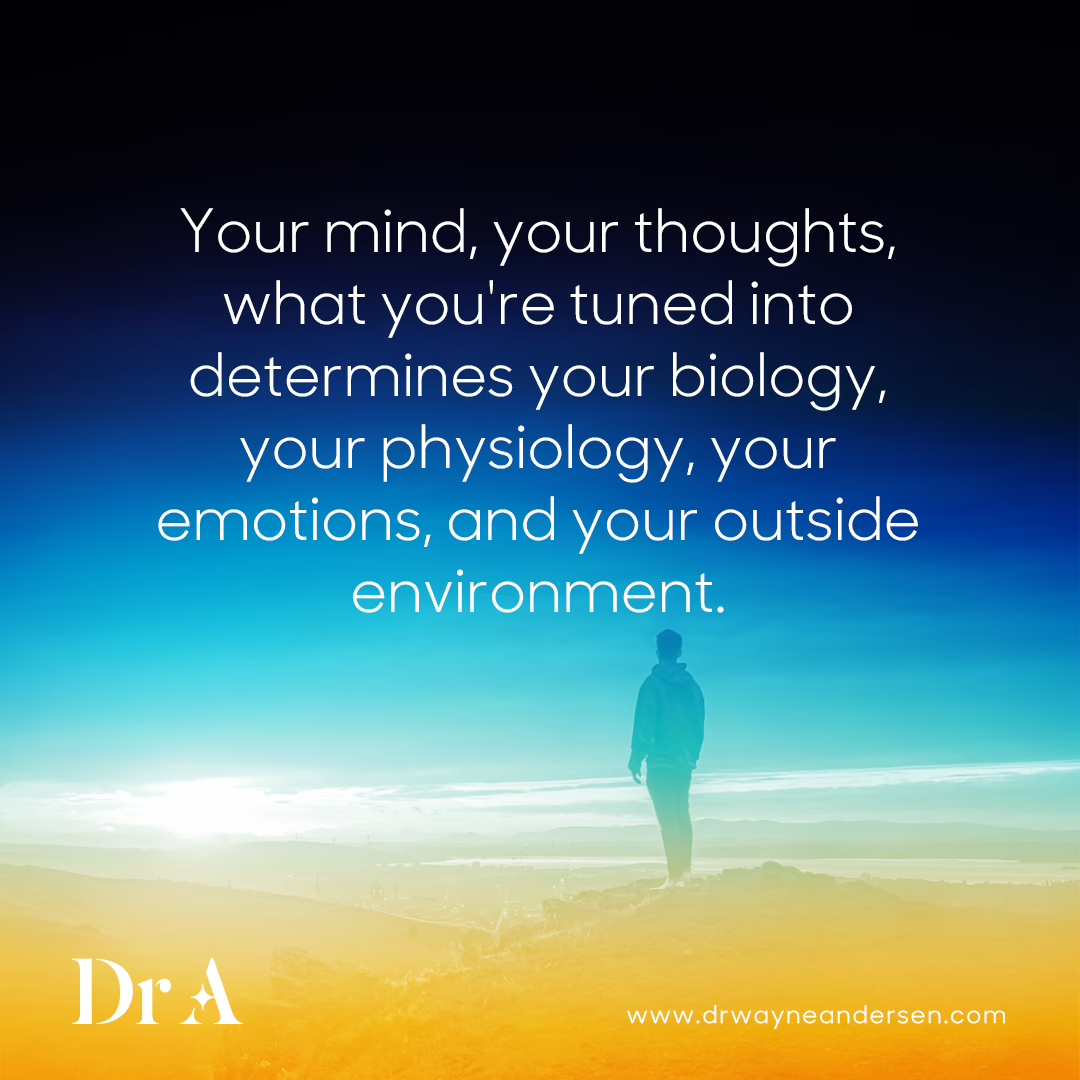
Your mind, your thoughts, what you’re tuned into determines your biology, your physiology, your emotions, and your outside environment. So, so critical. This is so important because basically, you know, there’s partially placebo to these GLP drugs. Yeah, they have an effect. They’re suppressing; they’re causing gastric fullness. They’re basically suppressing your cravings, but they’re also a placebo effect. And I’d love to see a study where they give people the shot with the good juice in it versus not the good juice and see what effect it has. That would be kind of cool. So, with that, now let’s be honest. You don’t want to sell yourself something that isn’t true. Some things won’t change. The world keeps sending us mixed signals. Real setbacks, real openings will arrive in the same week, sometimes the same day. But the bottom line is, the slide protects the talk from sounding manifestation. This slide tells you there is reality. This is your reality. This slide says you don’t get to control the things around you, but you control what signals come in. Just like the milkshake, you basically can tell yourself and show yourself I’m tuned into the abundancy. It’s— I’m on the ocean, which by itself is glorious. Today is a cloudy day. It’s not sunny. Yesterday was brilliantly sunny. I can see dolphins out there. Today the sun is mute, and is basically hidden. My background’s muted. It’s a very different environment. But I can choose to look at it and say, gosh, now focus on the thing that comes into vision, which are the delineation of the waves. And I noticed that when I got up this morning, I looked, oh, it’s not sunny out. And I didn’t go, oh, woe is me. It’s not a sunny day. I actually said, wow, look, I’ve never noticed before the way the waves are breaking out on the bank. I mean, that’s the difference. Tune in to the things that allow you to create what you want in your life because that’s what we get to choose. You basically get to choose and control what you tune into. That’s the whole thing. And you can make that choice again and again every day. You can actually build the environment you’re standing in.
Basically, what does that mean? It ties back to The Human Advantage theme. What all these talks are about. You are the chief architect of your life. You can become the Dominant Force and you can organize your life around what matters. And by focusing on those things, you’re basically taking out the clutter around you. Because if you’re allowing somebody else, even a different message – a message of scarcity that you see on TV, a message of danger overseas or somewhere else, something that happened and you focus on those and bring those into your current reality, you are blunting. And when you have a fear-based mentality, your ability to focus beyond a very small area. By design, when that tiger was coming towards you, you were 100% focused on that tiger 10,000 years ago. But instead, if the tiger isn’t there and it’s not real, why would you focus on all the things around you that do not bring you anything creative? You’re looking for the building materials around you in relationships. So, why hang out with people that are dysfunctional? Hang out with people that bring energy. They help charge your battery. Avoid the people that discharge your battery. You have control over those pieces into your life. And most importantly, know this, what you tune into, you create. The frequency tuning into this advantage, creative process versus the survival, which most people, the expectation that today will bring me more joy, more things into my life that are important to me. Attention on those things so you’re filtering out, because the world has never been more distracted than it is today. And to create the things that you want in your life. So basically, here’s the one question I want you to carry away with this week. What am I tuned into right now? And is the frequency I want to be creating, is it there? Does it allow me to create what I want in my life? So Rachel, that’s it. Let’s answer some questions. Let me get rid of this.
Rachel: All right. First up, we have Alison.
Dr. A: Okay. Hey, Alison!
Alison: Hey, Dr. A. I don’t have a question. I just have a thank you. I just want to thank you so much for giving me the words of what’s actually been happening. I’ve strung together five weeks now of keeping a promise to myself, of taking good care of myself, eating what’s going to fuel me while drinking what’s going to take good care of me, and making those choices that you said, doing that Stop. Challenge. Choose. And it’s working.
Dr. A: Wow, you look great. I see a big smile on your face and you know, your color, your texture. Let me just spend a moment on that because I don’t think people realize how powerful their minds really are. I mean, they hear it and they say, “Oh, my mind is everything.” But your physiology is affected by that. Your color, I can — remember last time, I could see the worried stress look on your face. Clearly, your metabolic health is better. Your skin is glowing. You got a big smile. You’re relaxed. Our vagal, our default mechanism, is our vagal tone. In other words, that’s the one that allows us to have a relaxed smile on our face.
[00:20:47] And that’s the part as — homo sapiens are tribal. We are meant to be together. And when we’re tribal, we’re in a relaxed state. And in that state, the muscles of our face are basically governed by our sympathetic parasympathetic nervous system. And when you have a high vagal state, which means you’re calm, you’re relaxed, your facial muscles soften, you get a glow, you have a smile on your face, and your physiology such that the blood flow is better, and you look healthy and rich. And that part determines everything. So now, and remember, you have a series of habits and behaviors that you had your whole life that got you where you were. Okay? They’re not going to go away overnight, but you don’t judge them. You simply — and do you like the idea of the frequency?
Alison: Yes. Yes. That’s going to be a new… [crosstalk 00:21:40]
Dr. A: Because now you can feel it. You’ll know it. And I really go back, you know, you’re a little young to remember, but we used to have to tune a radio with a knob and when we — did you ever just have to do that when you were little?
Alison: Uhhuh.
Dr. A: Yeah. So when you tune it, you know that there’s a sweet spot where all of a sudden it becomes this rich sound. And you know, you probably had your favorite station growing up that you like to listen to music. And if that station was off just a little bit, the music didn’t have that resonance. It didn’t feel and it was actually an irritation to you. Well, that irritation is because most people are dialed into the channel of fear, scarcity, and basically, I can tell you now, and it’s taken a long time, because it doesn’t happen overnight. You have to train yourself. We were trained to survive. And a 100,000 years ago in our environment, there were a lot of bad things that could happen to us. And so we ran on the amygdala, that neural tripwire, that little double organ in our brain that helps us diagnose and trigger response to danger. It was there for a reason. But most of the time now that organ is not responding to danger. It’s responding to perceived threats. Our ego gets away. Someone said something that made me look bad. Or I saw something in the news. Oh no, the B1 bombers. Oh no, what’s happening in our — listen, there is real clear and present danger in the world but 99% of it we have no control of.

You have no control over that. What you do have control over is one thing yourself, and do you want to live — and I always ask people this: if I could help you create optimal health, would you want that choice? And everybody says “Yes,” but most people go, “Oh, I don’t think I could do that.” The main reason why you can’t do it is because you’re tuned to the fear channel. So just simply — that metaphor of re-tuning ourself and noticing when the tuning is off a little bit, and we start hearing that static come up in our head. Don’t beat yourself up and say, “No. I’m not worthy.” Say, “Well, I just noticed I’m getting off frequency.” Get back on frequency. Get back to organizing your life for what matters. Become that you have the Dominant Force. You are the chief architect of your life. And I can tell you your life is a result of what you’re committed to. And that, you know, my dear friend Jim Dethmer kind of changed my — I hated the word commitment, because people say, “Well, I’m committed to do this.” And they didn’t want to do it. They had no desire to do it. They did not want to do it, so they were forcing themselves. Commitment, the way Jim describes it, is: commitment is what you’re committed to. If you’re 50 pounds overweight, then you’re committed to being 50 pounds overweight. If you’re sitting there anxious all day, then you’re committed to that. So commit yourself to the things that you really want in your life and start working on that. And the key modulator is right here.
Alison: Thank you.
Dr. A: Yeah, you’re welcome. Thanks. Okay, who’s next?
Rachel: All right, next up we have Teresa.
Teresa: Hello, Dr. A. Thank you so much for all that you do. It’s a privilege and a blessing to talk to you.
Dr. A: Thank you.
Teresa: So my question is about applying this to a very difficult and very important relationship in your life. Mine is with a child of mine and he went off into the world and I’ve always been a bit of a helicopter mother, and I’m just trying to navigate this, and he has recently become involved, you know, with a female and he’s in a new relationship and his relationship with the family has changed, and there’s some difficult conversations happening like, “Where are you? We miss you. We love you.” And I’m having a really hard time finding the positives in our relationship and how to fix it and how to let him know that I love him without him feeling that I’m being overbearing.
Dr. A: That’s a really good… and as a mom, and especially a helicopter mom that’s used to when you had — how old is he?
Teresa: He is 21 now. He just turned 21.
Dr. A: Okay.
Teresa: And he’s my fourth child. He’s my baby.
Dr. A: Okay. All right. And so, there’s a lot of stuff going on psychologically for you, right? A lot of emotions. It’s the last one that was in the home. You’re a mom. I got, I’m going to tell you some facts that you’re not going to like, but are the facts. He’s grown. And in the animal, we’re animals, okay? We are animals. We are the highest advance — that’s why we have The Human Advantage, because you have the ability to take what you’re feeling right now and you have the ability to basically decide how you’re going to respond to it so you can determine an outcome that works for you and works for him. Okay? He’s grown.
Teresa: Right.
Dr. A: I’ll tell you a quick story. So, in Annapolis, we lived on the water and we had a dock and at the end of the dock, we put a pole and put a platform on it for osprey and my girls were very young then and they would watch them and it was right out from my office. So, I got to watch and there was a process in nature that happened every year. The osprey would go south during the winter because it would get cold in Annapolis and in the spring they’d come back and we’d notice them come back. They’d start circling around and basically they’d kind of sit on the platform and then they would kiss and they would fertilize the eggs and then start having babies. And we knew they were getting ready to have babies because then they would gather sticks on the platform. Sometimes there was some of the nest left from the previous year, because they would come back, and then they put more sticks together and basically they build a nest.
Then they’d have their eggs. They’d hatch their eggs and then there was a process with their young. And now this is an accelerated process because they don’t live as long. We live to be on average — you as a woman, on average will live to be 85. And if you do all the things that I teach, you might live to be much older in a healthy state. So you have a great health span and lifespan. Okay. That’s a long answer to your little small question but it’s leading to a very important point. We then watch the babies hatch. Parents would go out. One would stay on the nest. The other would go get a fish. Bring the fish back. The mom or dad would eat the fish and then regurgitate and open their mouth and the babies would get some food. Okay. The next step was they bring the fish back, they tear off little pieces and feed the baby the little pieces. Then they throw the fish in the nest. Then they, basically, when the wind would come up, the babies would start practicing flying right over the nest so they could just drop down when they got tired. Then the parents would go sit up in the trees and you hear the babies this constant, this chirping from the babies because they were hungry. Babies then had to leave the nest, go feed themselves and then eventually within a couple months the babies would leave. The parents would stay a little longer and then everybody would leave and the next year the babies weren’t there. They were off doing their own thing. Okay, that’s nature
Okay, you’ve had a wonderful relationship… I mean, I don’t know. I’m making a story here, but it assumes it’s your baby. You had control over it. There was an up one down one where you controlled it. You took good care. You oversecured him. And now your son is responding by independence. That is the natural process that he should go through. As a young man, he’s out now doing his own thing. He’s finding his way in the world. He’s building his own relationship. And as a result, it feels like he’s abandoned you. He hasn’t abandoned you. He is simply dealing with a different set of probability in relationships. And your job now is to love him, not be needy. You got to stop being needy, that you need his love. You don’t need his love. You should be happy that he’s found somebody. And during the appropriate times when it does happen that you’re together, don’t say one word about how much you miss them. Just in that environment, create a positive environment where he’s glad he came and then basically he’ll go away. And the more time he enjoys that environment, the more he’ll come back to you. That’s it. And if you did the script right and over the first 21 years you developed a loving relationship, then that will come to fruition faster. If you had a crappy relationship, don’t expect it to get dramatically better. That’s the fact.
Teresa: It was very good, so.
Dr. A: Good! Then just give him space. Give him time. Don’t just — when he does interact with you, come from a space to — here we go. You ready? Your frequency should be one where every interaction he feels a sense of creative abundance, “Hi honey, how are you? Things are good.” Not being nosy. Certainly should be curious. Don’t, you know, create great, vibrant frequency so you’re both on the same frequency and it’s one of mutual respect for each other, loving each other, and basically over time all will be fine and get yourself a new hobby.
Teresa: A new hobby?
Dr. A: Yeah, get yourself something to occupy yourself. He’s not your job anymore.
Teresa: Right.
Dr. A: He’s no longer your job, okay? That was your job. You’re a mom, and mom, most important profession in the world. Being a mom, the hardest profession, and most loving, and you’ve lost that feedback that you had previously. The world is moving on and it’s time for you to change your frequency. Focus on things that bring joy and he’ll be back. Trust me.
Teresa: Awesome. Thank you so much.
Dr. A: You’re so welcome. All right. Who’s next?
Rachel: All right. Next up, we have Jan. Hi, Jan.
Dr. A: Hey, Jan.
Jan: Hey. Hi. How are you, Dr. A?
Dr. A: I am fantastic.
Jan: Awesome. So good to be on. So I have a question about this process, which I’ve appreciated learning this over the years and I’ve used it in my life so much, but there are days when I even though I know it and I’m trying to stay objective and step out of it and see it, like there are days when I feel like I cannot pull myself out of that whole focusing on, you know, the things that I don’t want and then more and more of those my reticular activating system kicks in and then that’s all I can see and I’m wondering how hormones can play in this process. Just thought I would ask that question.
Dr. A: Yeah. No, that’s a great — well, but here’s the thing. Hormones definitely have a place, okay? And chemical imbalances, all those things are real. And by the way,I know we bring it up at the beginning, but I want to make sure I’m not a psychotherapist. I’m a physician. I know a lot about how to help people create health in their life. But if we have significant hormonal or chemical imbalances, you know, that requires psychotherapy then I always seek a professional, but with that much said, the analogy, the metaphor I made today is really important, “Tuning the right frequency and amplitude.” So when you have a frequency that’s off, like you said you get into this kind of funk, right? That frequency you need to not give it any attention. Okay? In other words, there’s two, I didn’t really talk about amplitude today. I try to keep it simple. But when you tune into a frequency and you get this — okay, so when you’re tuning in, I’m going to use the metaphor of the radio. So when you tune in the radio, before you get it really clear, you turn the volume down, right? Because you don’t want to hear that. Same thing, by the way, if somebody has a single sideband radio. I have a VHF radio on my boats and we have a thing called squelch and so squelch is that sound in the background and when you’re tuning it you want to get just above when it makes that squelch sound and then you turn the volume up. Okay, you don’t turn it up and because it’s irritating the same thing with all that stuff going on in your emotions in your brain it’s irritating, okay? You want to turn the volume down. You want to do everything to — and the first thing you can do is basically switch out something. So if you’re feeling that way, take something that brings joy, something that’s positive, and I don’t mean positive thinking, I mean actually something positive in your life.
[00:34:22] Take that and focus on that. Start off that process to make it easier. A mantra is a good way to start because you have all this stuff circling there, right? A mantra is simply saying something to yourself very short amount of words like, “I love God,” or “I love the sea,” or “I love the wind,” or whatever you really love, something that really gets you, and repeating that constantly because what happens is it starts selectively having you focus in on this positive thing, right? Whatever that thing is, and that helps, that helps kind of dampen all the negative energy, okay. That’s the second thing, and then when you are tuned in you get it. So it’s fully resonant. It’s the pure sound. Then turn that up. So focus on that. So that’s increasing the frequency and get used to that, because your hormones are at the effect of your emotions, which are the effect of your thoughts. So all those things are modified in your brain, in your adrenal glands. Obviously, as women go through the perimenopausal period there’s changes in their estrogen, progesterone levels. And yeah, you know, if that part of it is that, then, you know, that’s one of the very few uses there is for artificial, you know, people are in this peptide craze right now. All that stuff is made by your body. All those things that are shooting into their body and now they’re trying to get it through their mouth, but the problem is most of that stuff is degradated when they take a pill. But all those shots basically are simply small amino acids which are transmitters that are released naturally by the body. So the first thing to do basically is try to do it, you know, through focusing on the positive things. But if you’re really, if they’re overwhelming you, if you, and I’m telling you what to do, but I would go get some help. I would really go get some help because that psychotherapy can be very helpful.
Jan: Yeah. It’s not terrible. Like I recognize it and I’m able to manage it, but I just sometimes get into that place where I see, I mean, and there’s always going to be challenges there. There will be, right? And we just get to see what we’ve got in front of us and think, okay, how is this working for us, you know, right?
Dr. A: Yeah.
Jan: Instead of happening to us. And I know these things. But there are those days and I’m sure I’m not alone.
Dr. A: Well, I want to give you some insight into that. I want to give you some insight. You’re not going to want to hear this. You intellectually, okay, you intellectually know Stop. Challenge. Choose. You know everything I’m talking about, but you haven’t become a full practitioner.
Jan: Yeah. No, I welcome it. I welcome it.
Dr. A: Yeah. No, no, and you haven’t, because if you had, you wouldn’t have them. I’m not saying — the difference is this. Listen, we’ve known each other a long time. I know there are things in your life outside of you that are challenges, that you have to deal with and those things, you’re a hero, but you do a marvelous job of that, but you take that job too seriously and so it affects you and so it’s the time for you just like the previous person I was talking with, right? Your mama days are over. Okay, this is, Jan, living your life to the fullest with the people that are around you, that surround you. You have to address the reality of certain things that happen in life. We all do. But you need to live in a state of joy. You are a beautiful creature, an incredible heart, and that heart needs to basically explode with joy every single day. And you’re the only one. You’re the only one. So focus more on yourself, take care of yourself, continue to practice this and pay attention to the frequency and really — like I talked about earlier, three times in the day when I get up, you know, I happen to do it basically I have a Miele coffee maker which unless it wants to tell me something I got to do to it. I push a button and it makes me a beautiful cup of coffee. And when I push that button, I say, “Boom, I just turned on the frequency of abundancy and joy throughout my day.” And I can tell you midday, I check, like right now, I can tell you, well, I’ll get off this call. And even though it’s been an hour of my time, it took me several hours to prepare the talk. It brings great joy to me. And I’ve tuned into something because I’m now translating. And if I help one person improve their health and their life and their thoughts on this and bring more joy, then it’s worth it. And you know, basically, because that’s kind of my purpose. My purpose is to help people. So my point is, you help so many people. You’re such a gentle spirit and full of such heart. The person — in order to keep that spirit alive on this world as long as it can be, the primary person to take care of first is you. Okay?
Jan: Thank you.
Dr. A: And that’s all I had to say about that.
Jan: Thank you. It’s great to hear it again. Thank you so much.
Dr. A: You’re so welcome. All right. Okay. Who we got, Rach?
Rachel: All right. Next up, we have Teva. Did I get that right? [crosstalk 00:39:41]
Teva: It’s Teva
Rachel: Teva. I’m sorry.
Dr. A: Teva.
Tea: That’s okay. It’s a 50/50 chance on that one. Anyway, thank you for this. This is actually the third time I think I’m talking to you. I don’t know if you remember, I started the program, it’ll be three years in January. My first two years, I had a brain tumor that I didn’t know that I had. I had a meningioma in my prefrontal cortex. Had it removed last November. Physically, I’m great. I was still able to release 100 pounds on the Optavia plan.
Dr. A: Wow. Congratulations.
Teva: Uhhuh.Thank you. Thank you. And I’m sure that had something to do with my, you know, recovery and the success that I had from my surgery. You know, it’s much easier to face surgery at 115 pounds than 215 pounds.
Dr. A: Absolutely. I’m a cardiac anesthesiologist.
Teva: Yeah. I know. I know. I know. I know.
Dr. A: That’s very true. That is very true. Very true.
Teva: So my point, the reason I’m bringing it up is like I wasn’t able to read anything. So for me, and I’m just plugging the wind calls that we had in our, you know, whatever were good because I got on twice a day and I got what I needed. I stayed in the community and whatever it was, it worked for me, you know, and because it was my prefrontal cortex that was affecting my emotional regulation, my impulse control, and my executive functioning. So I was raging. This is going on for years, but really the last two years were severe. Right. I was just about to have a seizure, right? And I don’t know if some of that behavior that I still kind of go to is because I was doing it for so long, you know, now that the tumor’s gone and I’m healed, right? I shouldn’t be doing that. So I have a history of addiction, you know, from a kid. I was raised in a broken home. My mother was an alcoholic. I had, you know, my three sisters, all older, all had, we all had eating disorders. Like, our first addiction for all of us was food from way back when, right?
[00:41:51] So, I’ve been sober since 1989. And I guess, trying to think of what I wrote when I wrote the question. So my mom died 10 years ago. I haven’t had contact with any of my three sisters since then. Not my choice, their choice. And I just found out that my uncle is in palliative care. He’s 90, right? And I reached out to my three sisters with a quick text just to let them know because I figured that’s what I would want, you know, if the situation were reversed, just information to let them know. I heard from one of them. The other one I didn’t hear from at all. And the third one, her boyfriend texted me back to say she has metastatic urethral cancer and has opted to have, you know like, also palliative care and whatever. When I finally talked to him, it sounds like it’s all going to be, I mean, not a quick process, but it is what it is.
So I’m trying to understand how do I… it was easier when I didn’t have contact with them. Just was. I’ve had therapy. I’ve had recovery and none of them have. So being involved with them in any way is triggering. You know, it can bring up a lot of old stuff and I don’t know if I’m questioning myself. Is it like — am I avoiding or is it self-preservation? Like how do I take care of myself still and not slip back into old patterns, old behaviors, use the program and the tools of the program, and, you know, the fact that the support in the program has changed for me personally, because I relied so heavily on that daily contact twice a day, you know what I mean, so this is an adjustment, also it’s an adjustment and honestly I’m being fully, like, what’s the word… full…
Dr. A: Full disclosure.
Tea:Thank you. Full disclosure. I have not read the LifeBook fully and I have not read The Habits of Health fully because I couldn’t, and now I’m trying to get into the habit of doing that. But I am tapped into the community. I’ve done the challenges back to back to back just to have that connection. That’s important to me. So, I don’t really know what my question is. It’s just I have a lot going on and I’d like to be able…
Dr. A: No, I understand that.
Tea: I want to ask one more quick thing. I put in the comments, in the chat, you know, I said the serenity prayer, right? God grant me the serenity to accept the things I cannot change, which is basically everything outside of myself, right? And courage to change the things I can, which is my attitude, my actions, and I added on because you were talking like my choices, right? The choices I make.
Dr. A: Three things. You have three things you have control over. Your paradigm, which is your orientation, and that’s why I just finished this talk about, is about frequency, which we’ll spend just another — second is basically your decisions or your choices, and third is your behavior. You have no control over your sisters. You have no control over cancer. You have no control over the external environment. You have complete control over how you respond to your environment. You have complete control over that. So all you’ve done first of all, you’ve done admirable. You’ve gone through some life-changing events. You had some physical things, meningioma. You basically had chronic, extreme obesity. You had a series of patterns that were brought up as a little girl. All those things are in the past. You’re out right now walking. Okay? Which is what I like to call a positive habit. It’s a Habit of Healthy Motion. Right? You’ve got a dog as a companion. I just saw your dog.
Teva: Yeah. I’m a dog walker.
Dr. A: Okay. You’re a dog walker. Okay. But you have a dog that you’re interacting with, which brings us great joy. Okay. You’re out in nature. You’re in the sun. Your super optic chasm has responded to that. You’re wide awake. You’re alert. Those are the things you have control over. You don’t have control over everything else. So again, I would go back and I’d watch this video again when you’re home and you can really focus and pay attention to each individual piece of it. I went, took you through a loop, and focus on in the morning when you get up, find a cue. So you have an intention to basically do something to get you focused on all the good things because you mentioned all those things that are positive in your life. Focus on those. In terms of your family, you have a distant, very very casual relationship with your relatives. You haven’t been part of that environment for a long time. If it makes sense and in the interactions you have — very similar to when I’ve talked to the last two viewers — is in those relationships when you’re together be kind, be loving, don’t be needy, don’t sit there — and make it a positive experience for them, and over time those relationship may rebloom you don’t have control over anything other than your output so if you look at some of my earlier forms, I show a picture of internal stability and external equilibrium.
That means inside everything that comes into you, you’re tuned into an abundant channel and everything you exude out of you creates external equilibrium. In other words, in your relationships with the dog, with friends, with family, those things you add a calmness to that because you have done all this work. And whether you read my books or not, take the principles. You can also do the audios. I have a series of these forums that I’ve done now for several years on drwayandersen.com. There is a library of all these. Pick the ones that seem the most relevant. They’re all titled and start looking at one. Look at one a week or maybe depending on how much time you have, watch one in the morning. Watch one in the morning. Each time and every one of those I give you exercises going to the mental gym in order to help you improve to help you tune in so you can amplify. There is a tuning fork, basically, a frequency and that frequency of abundancy is very different than the one of fear and loss, and you were dialed in for many years to the fear frequency, basically, to the scarcity the survival frequency and now you have the opportunity, because you’re the Dominant Force in your life, to tune in to the abundance, to tune in to the creative tune, in to what brings joy into your life. You can organize your life around what matters most and bring joy, and then surround yourself with people, right? Five closest people in your life. Pick people that together, you’re joyful together, you’re healthy together. Find some, you know, walk with people, not just dogs. Go do things you like to do. Stay in that frequency and your life will continue to get better and better.
Teva: Okay. Thank you.
Dr. A: You’re so welcome. Okay, we have time for probably one more, Rachel.
Rachel: All right, our last question is from Amber.
Dr. A: Hey, Amber!
Amber: Hey, Dr. A. How’s it going?
Dr. A: Good. How are you? It’s so good to see you.
Amber: Good to see you as well. So, okay. This is my…
Dr. A: I love your background, by the way. I love that vase. Are those real or fake?
Amber: Yeah, this is my actual background. It’s not virtual.
Dr. A: I love it. It’s beautiful.
Amber: I curated it specifically for happy things I like. Right?
Dr. A: No, it makes me… immediately brings great joy. It’s beautiful. It’s like a beautiful Lily Pulz or whatever her name is. Right?
Amber: For sure. Thanks, Dr. A. Okay. So, I want you to help me see the difference between just looking for the positive, like, okay, let me say this: I actually expect to succeed like that. I think that that is part of my mindset. Where I come into trouble is like the unmet expectations. Like I expect to have good relationships. I expect to have success in my finances and in my health and so whenever things pop up, when it kind of throws me off, that’s where I struggle because I feel like I try to tune in to the right frequency but then, you know, things hit me and that unmet expectation I’m just like, why is this happening this way? And so I want to know, how do I change that frequency because obviously I’m probably just pretending I’m on that frequency, without ignoring the emotions that are under there. I start pushing emotions down. I become a stress ball. I don’t know. So that’s kind of what I’m dealing with. It’s the unmet expectations where I really struggle.
Dr. A: No, that’s a great one. That’s really insightful… and also, you have insight. And the answer is that if that’s happening, it’s rather than think of them and judging yourself, think, “Wow, I’m really curious. Why did that happen?” Because that will help you. We all are on a path. Even the highest conscious yogis, right, can get triggered and there’s things that can happen. And a lot of times because you are intellectual and this kind of, like with Jan, right? Very intellectual. You’re a master at studying the process. You know a lot about Stop. Challenge. Choose. You know a lot about emotional, psychological flexibility. You know a lot. You’re you. So at an intellectual level, you’ve got it right. You’ve got it. But I remember when I first met you and I’ve seen tremendous growth. But where you were when I first met you is a result of you not having the skills back then and growing up in whatever environment you grew up in. Whatever happened to you during those periods, they’re patterns and things that you, you know, until we’re five, our prefrontal cortex doesn’t work, right?
So, when you’re really young, things happen and you handle them emotionally, right? Like, you know, you and I know you know this, but ideal belief reality, right? We start thinking that, you know, that we were told once that we were stupid, casually said by somebody that we respected, our parents or anybody, and rather than saying it that wasn’t the smartest thing to do, I mean because I remember I got it when I was young, “Why are you so stupid?” Right? And what happens is you start thinking that and then you build everything around showing why you’re not stupid, right? Like, you know, becoming a National Honor Society, becoming a PhD, becoming a doctor, a lawyer, winning the Nobel Prize, but if you underneath, still think you’re stupid, none of that matters because you’re doing it to prove something that you don’t believe about yourself.
[00:53:01] Okay. So, I think at the level of intellectualization that you have, these are curious little things that you should journal and write them down when they happen and you’ll see a pattern come out of it. And that pattern will lead you, it’s like breadcrumbs, right? It will lead you back to what the underlying energy inside of you that’s causing these things. Now those are things that you have control over. You have no control over the outside world. So the first thing, you know, like the last lady was talking about the serenity prayer, it’s important to realize what do you have and what you don’t have control over. Right? So if — and I’ll tell you, just happened to me last month, somebody basically took an email and scammed me for money. I mean, a lot of money and I didn’t have any control over it. I had no control over that. I learned from it something that I need to do to add another layer that can prevent that from happening again. But that’s a life lesson and rather than sitting and saying woe is me, that happened. I said, “Okay. That’s a painful lesson, but what did I learn from it?” And then I made the modification and I haven’t thought about it until right this second again. I haven’t thought about it in a month. Okay. So it’s understanding first what you have control over, what you don’t. What you do have control over is the frequency. Okay? And that’s so so critical. Like you changing your environment, your environment aesthetically is beautiful. It’s serene. It’s calm. It’s got — it’s fun… fun…. What is it?
Amber: Feng shui.
Dr.A: Feng shui! Yeah, it’s feng shui. It’s beautiful. It’s gorgeous. In fact, it’s better than feng shui. It’s just absolutely exquisite. And you, the way you’ve got that radiating light from it, right? That comes out of that. Is that a painting?
Amber: Yeah.
Dr. A: Yeah. And that’s the light. That’s the light. And it’s interesting because it’s right behind your head. So, metaphorically, you’ve created an environment where basically it exudes calmness. It exudes beauty. It matches your skin, you know, your color, and it’s beautiful. So, that you have control over. We have 100% control over that, right? And mine sometimes I look at, you know, when I see it on video, I look and say it’s a little cluttered. But I don’t have it here for that reason. I have it here because there’s really important — obviously my love for the ocean and sailing. A picture of me, I know you’ve seen this picture before, I have a picture of me when I was 5 years old, sitting in Maryland on a little boat. And I look at that picture and that was me dreaming of being a ship’s captain. When I didn’t have enough money, my uncle made me a little piece of 2×12 and made it look like a boat, and I would float it. That was what I had. But I dreamed of being a ship’s captain, and behind it is The Habits of Health, one of my, the ships that I sailed halfway around the world. So the bottom line is that brings me joy and is it aesthetically — but you know, it is what it is. But my point is, first thing is in every one of these things that happened, that kind of sideballs you, hits you like a ton of bricks, ask yourself, did I have any control over this? Was something that happened here, did I have control? And if you didn’t, just chalk it up, what are the lessons — in other words that’s the time that is already consequences of this that I need to make — because fear — real fear — is a time for change. A real fearful thing that’s happened means I need to make a modification. If something happened, if something happened that put me in harm’s way or put my family, then that’s something I have to change. But if it’s something that you can, that you didn’t have any control over, just take the lesson from it and move on. If it’s something that you had control over, then internally something snapped or went off in here; then use it again as a breadcrumb to lead you back to what are the areas you need to work on. Because there are things, because you’ve intellectualized this, your brain is so, your mind is so strong it can cover up all the warts, and we all have warts, right? And so that’s what I would do, and I would journal on it and then look for repeated patterns, and if you want, obviously we’ve known each other a long time, if you ever want to talk, you know, offline, we can do that.
Amber: Yeah, it’s probably more of the, I don’t know, I go back, and I go, “Oh, why didn’t I make a better decision with that?” You know what I mean? And so that’s probably where I go more.
Dr. A: Don’t beat yourself up about that. Don’t beat your — that has no value. You’re not your own… You can’t grade yourself. You can’t grade yourself in terms of how good or how bad you are. Okay? There’s no such thing as good or bad, basically. I mean, there’s evil, but I’m not talking about that. I’m talking about it’s not that, “Oh, why did I make that mistake and beat yourself,” that’s looking towards perfectionism, and perfectionism is not a good trait. It’s a bad trait because you have to live…
Amber: That’s probably more what I picked up, Dr. A. Not that you’re so stupid, but you’re so perfect and great.
Dr. A: Yeah. Yeah. Well, and that can be it. But the point is, yeah, who judges that? Nobody judges that. Basically, that’s an internal process that you use to beat yourself up to get better. Now, if you’re an athlete, when you play a sport, if you’re not good in your serve, right, then note it, practice it, right? That’s reality. But as you know, most of the stuff we have is one big story we made up, right? Yeah. Cool.
Amber: No, appreciate you, Dr. A. That’s really helpful. Thank you.
Dr. A: All right. See? All right. Bye. Okay, Rach. We’re at 12:58; that’s time. If you have a question, please come on next time. Make note of what you want to ask and make sure you get in the queue right away next time. Let Rachel know that, and we will finish this on time. Remember, ask yourself three times a day, get up in the morning, use some cue, whatever it is — pouring your coffee — I don’t care what it is, and make the decision. I’m tuning in to the frequency of abundancy of creating. These are the things I want to bring into my life today. These are the things I’m focused on. These are the things that are important for me moving into the future. Lead from that future. Organize that and put yourself in position to act on those things today. Midday, catch yourself and see: where am I now? Am I fully focused on abundancy or am I going off frequency? Am I fear-based today? And at the end of the day, do an assessment. Where were you today? And every day gives you the opportunity to get a little better. So, God bless, and you guys have a great week. Bye.